Amazon Web Services has introduced TorchNeuron, a native PyTorch backend that lets developers run existing AI model code on AWS Trainium accelerators with far fewer migration changes. Announced on October 19, 2026, the tool is set for an Apache 2.0 open-source public beta on October 20. Its appeal is practical: a team that built a model for a GPU can test a different class of accelerator without rebuilding its entire training or inference stack.
What TorchNeuron actually changes
PyTorch is the widely used open-source machine-learning framework behind training and deploying many AI models. Moving a PyTorch project from Nvidia GPUs to custom accelerators has historically involved specialized runtimes, conversion steps or code changes. TorchNeuron registers AWS Trainium as a native PyTorch device, allowing standard framework operations and familiar debugging and distributed-training tools to work on the new hardware.
In the simplest case, the difference is a device selection: code that sends a model to CUDA can instead send it to Neuron. Programs already using PyTorch's device-agnostic torch.accelerator interface may not need even that change. Amazon demonstrated an existing training script running on a conventional accelerator and on Trainium with the same learning behavior, changing only the hardware setting.
A concrete PyTorch example
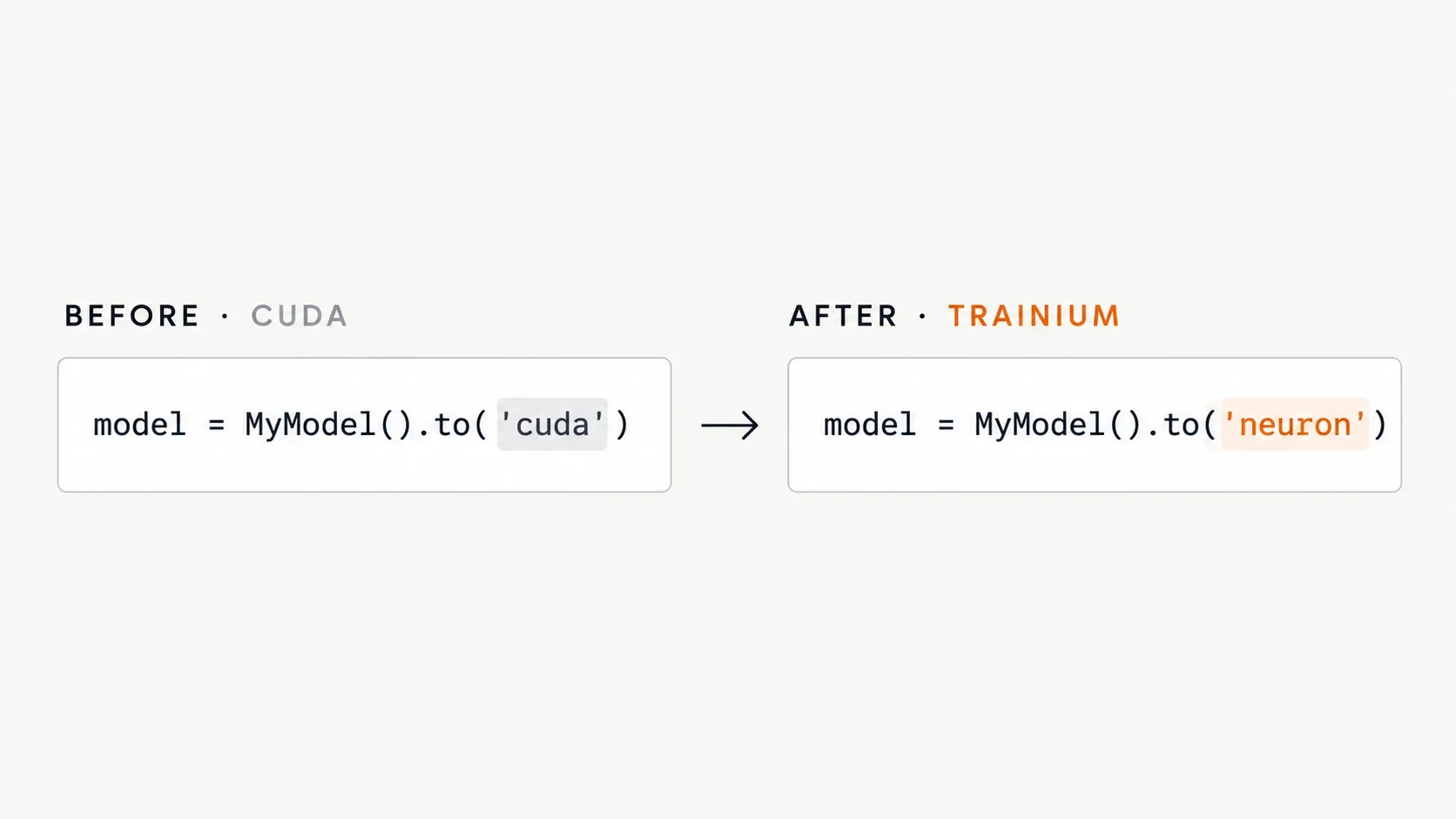
For supported workloads, the change can be as small as replacing one device target. This example reflects the documented device-switching pattern, not a guarantee that every CUDA-specific application works unmodified:
# Typical GPU target
model = MyModel().to('cuda')

# AWS Trainium with TorchNeuron
model = MyModel().to('neuron')

# Optional compiled path
model = torch.compile(model, backend='neuron')
Underneath that short example, TorchNeuron supports eager execution for iteration and debugging, torch.compile for optimized execution, common torch.distributed APIs for larger training jobs, and the Neuron Kernel Interface for custom hardware-level operations. Supported accelerators include Trainium2 and Trainium3. These capabilities are aimed at both model development and production serving.
What can developers build with it?
The early-use examples go beyond chatbots. Amazon says teams building real-time speech systems, robotics, world models, self-driving applications and biomedical research workflows have already worked with the backend. Voice AI developer Cartesia reportedly moved a standard inference pipeline to Trainium with minimal PyTorch modifications. The Lieber Institute for Brain Development is exploring how Trainium can support computationally expensive biological and molecular research.
Reuters reported that more than 30 early customers were using TorchNeuron across areas including robotics, world models and voice AI. AWS also pointed to voice-AI company Deepgram, saying a Trainium migration improved the amount of audio processed per dollar by about 70%. That figure is a reported customer example, not a benchmark proving equivalent savings for every model or cloud deployment.
Why this challenges Nvidia
Nvidia's advantage in AI has never been limited to GPU hardware. Its CUDA software ecosystem, libraries and optimized workflows have helped make Nvidia systems a default choice for researchers and developers. TorchNeuron tries to remove some of the switching cost: if a team can test Trainium with the PyTorch code it already maintains, it can compare real operating costs instead of rejecting an alternative accelerator because porting would take too long.
The PyTorch project also describes the effort as part of a broader move toward hardware-independent development APIs. Amazon is contributing upstream compatibility work and says its backend integrates with tools such as TorchTitan, Hugging Face components and vLLM-based serving. This does not mean CUDA has been replaced, only that another hardware path is becoming easier to evaluate.
What is available now — and what still needs testing
TorchNeuron was announced on October 19 ahead of its planned October 20 public-beta and open-source release under the Apache 2.0 license. It targets AWS infrastructure equipped with Trainium2 or Trainium3; it is not a tool that turns a normal Windows laptop or Mac into a Trainium computer. Running a workload still requires compatible cloud instances, the relevant Neuron software environment and validation of model correctness and performance.
A small device change is not a universal promise of zero engineering work. CUDA-specific extensions, unusual operators, low-level kernels, model-parallel settings and performance tuning may need attention. AWS Trainium compute is a paid cloud resource even though the TorchNeuron backend itself is open-source. Developers should test compatibility, numerical behavior, throughput, latency and total price on their own workload before migrating production traffic.
How to decide whether to try it
For a practical first evaluation, teams can compare one representative PyTorch model across their current accelerator and a Trainium instance:
- Start with a small, reproducible training or inference workload.
- Move the model to the neuron device in a supported environment.
- Check output quality or training convergence against the original run.
- Measure latency, throughput and total cloud cost rather than relying on advertised per-chip pricing.
- Only then test larger batches, compilation and distributed execution.
Why it matters
TorchNeuron is a software story with hardware consequences. Developers may finally have a more realistic way to try different AI accelerators using familiar code. For startups, the potential upside is less time spent rewriting infrastructure and more freedom to choose the price-performance trade-off that actually fits the product. Its success, however, will be decided by independent production tests, not by the simplicity of a launch demo.
Primary sources: PyTorch's technical announcement and Amazon's product overview. The launch and early-user context were also covered by Reuters.