Anthropic launches Claude Opus 5 for long-running agents and coding
Published
Anthropic has launched Claude Opus 5, a new flagship model designed for long-running agents, software engineering, professional analysis and complex m...
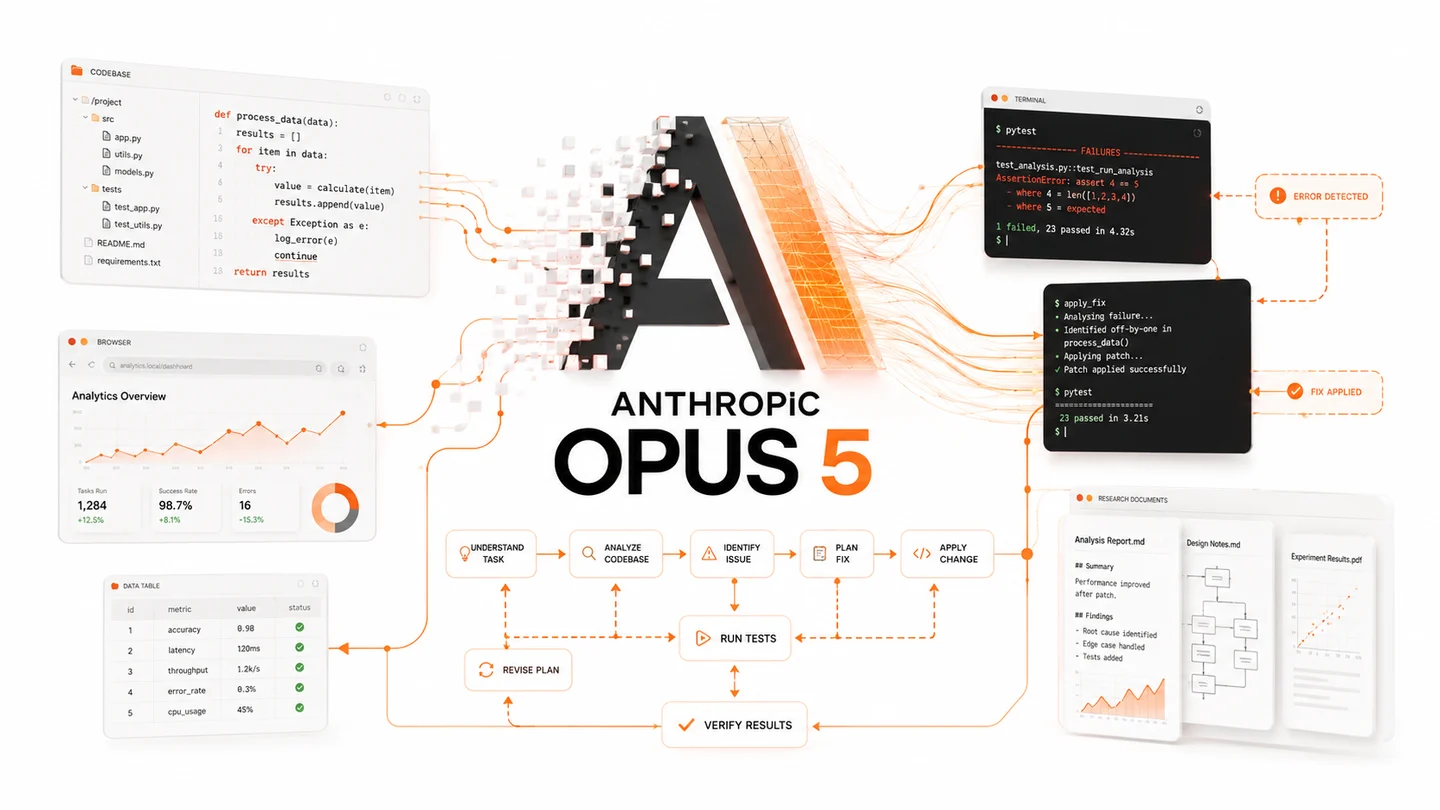
Anthropic has launched Claude Opus 5, a new flagship model designed for long-running agents, software engineering, professional analysis and complex multi-step work.
A new default for Anthropic’s premium tier
Claude Opus 5 is available across Anthropic’s platforms and is now the default model for Claude Max. Anthropic describes it as the strongest model available on Claude Pro and says it approaches the capability of Claude Fable 5 at roughly half the cost per task.
Focus on coding and sustained agent work
The model is built to remain effective across longer workflows rather than only producing a strong first response. Anthropic says Opus 5 is better at verifying its own work, iterating after failures, tracing the root cause of bugs and maintaining context through large codebase changes.
In examples shared by the company, the model created its own computer-vision pipeline to reconstruct a mechanical part, found an edge case missed by an existing software patch and built a test harness when no live data source was available. These examples come from Anthropic and early-access customers rather than independent production audits.
Performance claims
Anthropic reports that Opus 5 leads its tested models on several coding and knowledge-work evaluations, including Frontier-Bench, GDPval-AA and AutomationBench. The company also says it performs close to Fable 5 on selected coding tasks while requiring less cost and fewer reasoning resources.
Opus 5 remains behind Claude Mythos 5 on offensive cybersecurity and certain high-risk biological research tasks. Anthropic says the new model was intentionally not trained as a specialised cyber model.
Pricing and faster execution
Claude Opus 5 is priced at $5 per million input tokens and $25 per million output tokens, the same base pricing as Opus 4.8. A Fast mode runs at approximately 2.5 times the default speed and is offered at twice the base price.
New developer controls
Anthropic is also introducing two beta features alongside the release. Developers can change the tools available to Claude during an active conversation without invalidating the prompt cache, and API users can configure automatic fallbacks when a request is blocked by a safety classifier.
Safety and limitations
Anthropic says Opus 5 produced its lowest measured rate of misaligned behaviour among recent Claude models in the company’s internal audit. Those findings are vendor-reported and do not eliminate the need for human review, access controls and monitoring in long-running agent deployments.
Practical significance
The release reflects a shift from models that mainly answer prompts toward systems expected to own larger portions of a workflow. For developers and professional teams, reliability across planning, tool use, verification and revision may matter more than a model’s best single benchmark score.
Anthropic announced the model in an official product release .
Source: Anthropic