This failure-checklist prompt catches plausible AI errors before the final answer
Published
A practical prompting technique circulating in the r/PromptEngineering community suggests asking an AI to predict how its answer could look convincing...
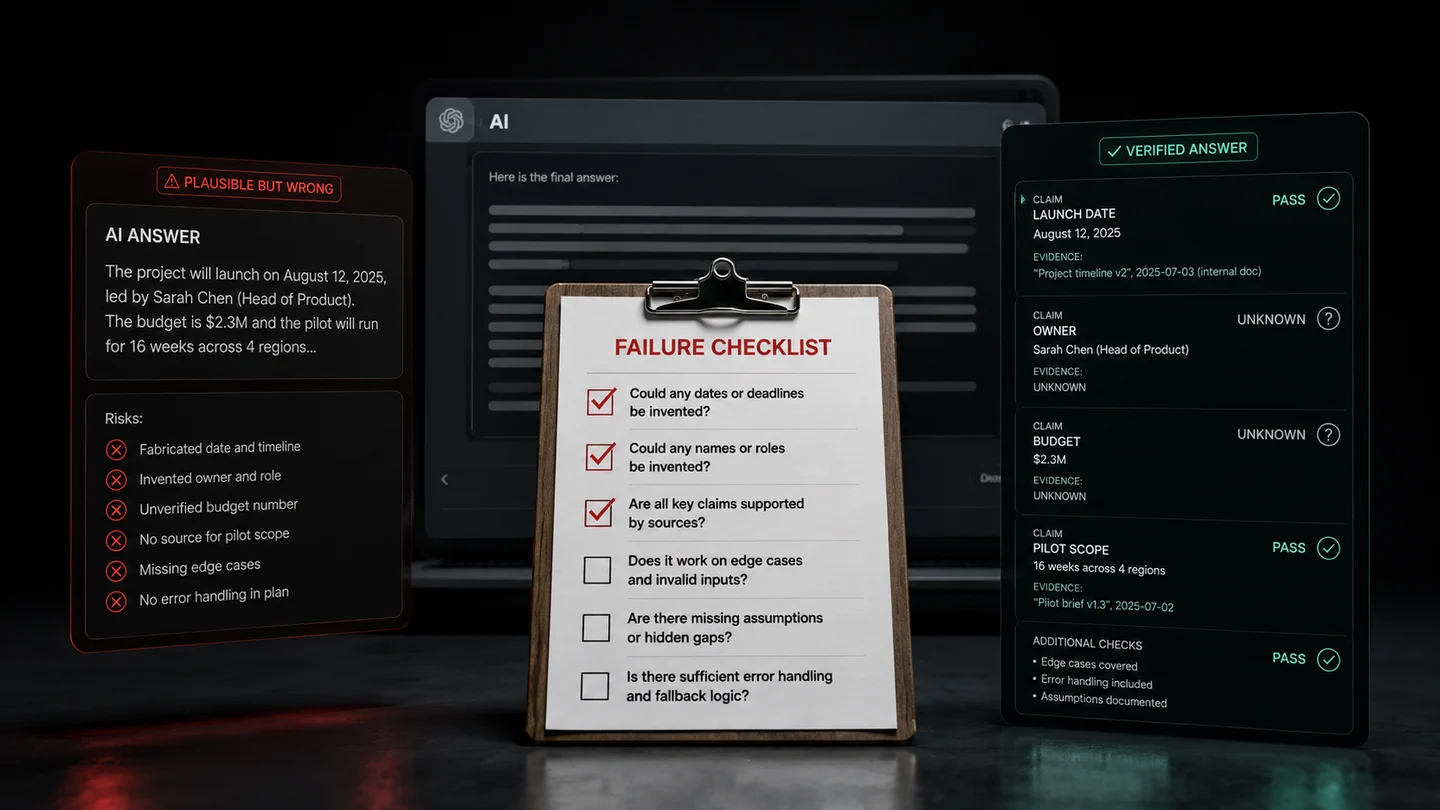
A practical prompting technique circulating in the r/PromptEngineering community suggests asking an AI to predict how its answer could look convincing while still being wrong before it begins the main task.
The core idea
Instead of requesting the final answer immediately, the user first asks the model to identify likely failure modes. Those risks are then converted into explicit acceptance checks that can be applied to the final output.
The method does not make a model reliable by itself. Its value is that it turns vague quality control into a visible and repeatable review process.
A reusable prompt
Before completing the task, do the following:
1. List five ways an answer to this task could look plausible but still be wrong.
2. Convert those failure modes into concrete acceptance checks.
3. Complete the task.
4. Review the result against every acceptance check.
5. Mark any unsupported claim, missing input or unresolved uncertainty as UNKNOWN.
Return three sections:
- Failure checklist
- Final answer
- Verification report
Where the pattern is useful
For meeting notes, the checklist can flag invented owners, deadlines or decisions. For research summaries, it can require support for claims and dates. For spreadsheets, it can test whether formulas work beyond sample rows. For code, it can force checks for error handling, edge cases and assumptions.
Add an evidence gate
A useful extension is to require exact evidence for every important claim. For example, a meeting-summary prompt can ask for the source line supporting each owner, due date and decision. If the evidence is missing, the model must return UNKNOWN instead of filling the gap.
Why this works better than a generic self-critique
Generic instructions such as “check your work” do not define what should be checked. A failure checklist creates task-specific criteria before the model becomes committed to one answer, making the review more focused.
Important limits
This is a community workflow, not a guarantee of factual accuracy. The same model can still miss errors during both generation and review. High-stakes outputs should be checked against original documents, test results or independent sources.
Practical significance
The technique is useful because it improves the review process without requiring a long prompt framework. It can be added to research, coding, analysis and content workflows as a compact quality-control layer.
The workflow was shared in a recent r/PromptEngineering discussion .
Source: Reddit — r/PromptEngineering