Gemini 3.6 Flash begins rolling out in GitHub Copilot
Published
GitHub has started rolling out Google’s Gemini 3.6 Flash model inside GitHub Copilot, giving developers another option for coding, web and app develop...
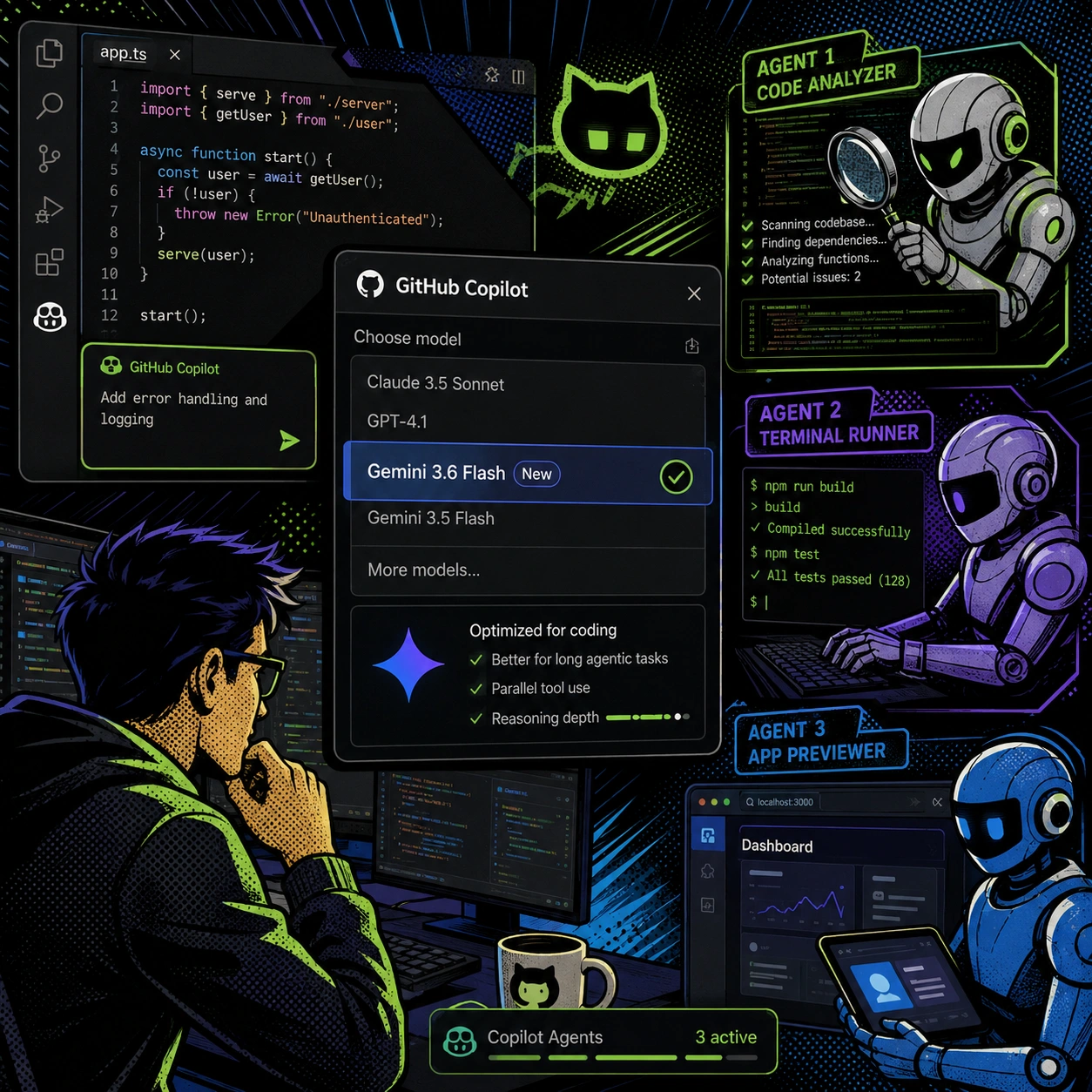
GitHub has started rolling out Google’s Gemini 3.6 Flash model inside GitHub Copilot, giving developers another option for coding, web and app development, and longer-running agentic tasks.
What changes for developers
Gemini 3.6 Flash can be selected from the Copilot model picker across supported development environments. GitHub says the model is designed to handle coding work while also supporting configurable reasoning effort and parallel tool use for more complex workflows.
Where the model is available
The rollout covers Copilot Pro, Pro+, Max, Business and Enterprise plans. Developers will be able to use the model in Visual Studio Code, Visual Studio, Copilot CLI, the GitHub Copilot cloud agent, the Copilot app, JetBrains IDEs, Xcode and Eclipse.
Gradual rollout and administrator controls
Availability is being enabled gradually, so the model may not appear for every user immediately. For Copilot Business and Enterprise accounts, administrators must first enable the Gemini 3.6 Flash Preview policy in Copilot settings before team members can select it.
Performance claims
According to GitHub, early testing showed higher task-completion rates and better token efficiency than Gemini 3.5 Flash across coding and agentic workflows. These results are based on GitHub’s own testing and may vary depending on repository size, task type and tool configuration.
Pricing
The model is billed at Google’s provider list pricing under GitHub Copilot’s usage-based billing system. Developers and administrators should review current model pricing before using it for large or long-running agent sessions.
Practical significance
The addition gives Copilot users more flexibility when choosing between speed, reasoning depth and cost. It also reflects GitHub’s broader strategy of turning Copilot into a multi-model coding platform rather than tying developers to a single model family.
GitHub announced the rollout in an official changelog post .
Source: GitHub