Google launches Gemini 4 Argon for coding, enterprise work and cyber defense
Published
Google has introduced Gemini 4 Argon, a new frontier model designed for long-horizon reasoning across software engineering, enterprise knowledge work ...
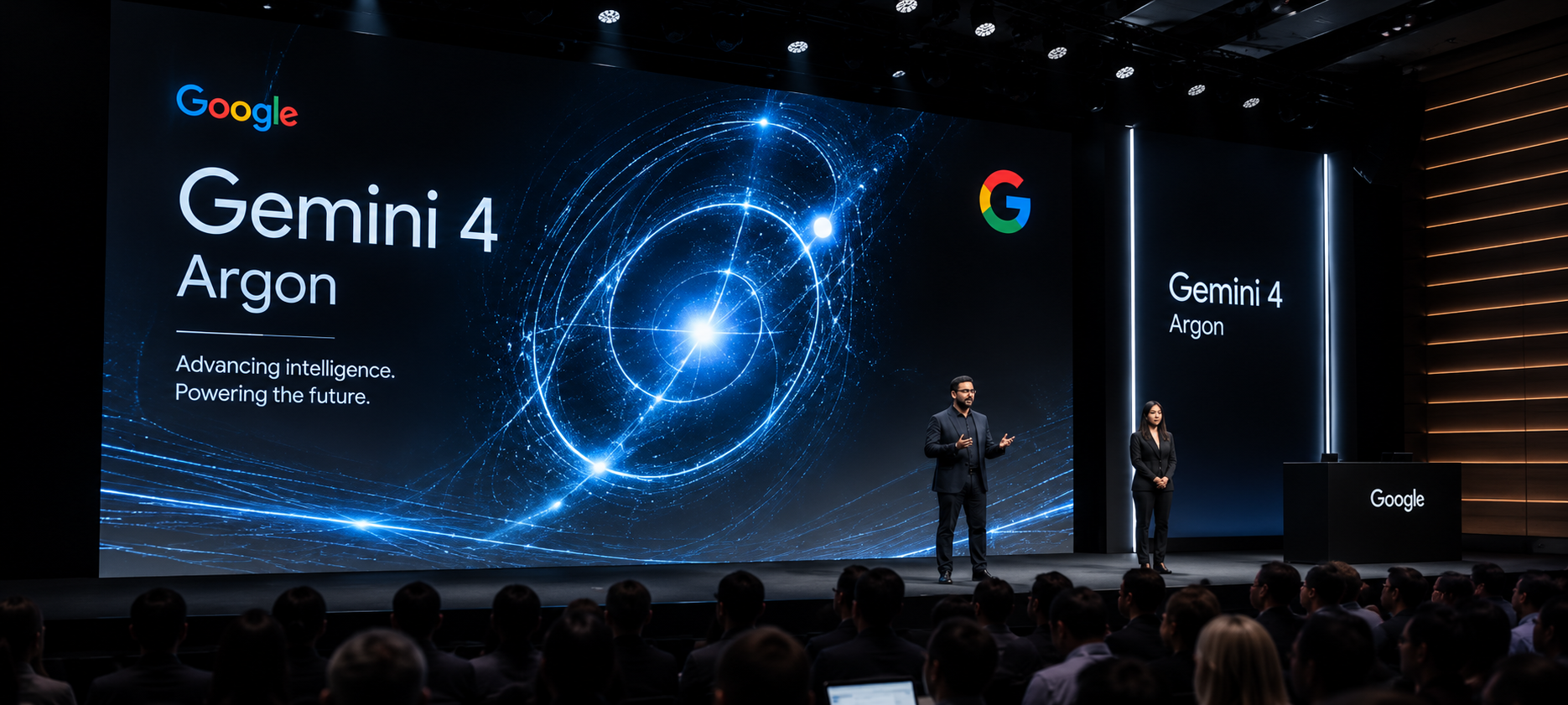
Google has introduced Gemini 4 Argon, a new frontier model designed for long-horizon reasoning across software engineering, enterprise knowledge work and defensive cybersecurity.
A 1 million token output limit
Argon expands the model's output limit to 1 million tokens, up from 64,000 in the previous generation. Google says the larger budget allows the model to sustain much longer reasoning trajectories, generate larger artifacts and work through complex problems without repeatedly restarting.
Google is already using Argon internally
Google says thousands of employees are using the model for debugging, research, writing and large-scale engineering work. Internal examples include optimizing quantum-computing subroutines, identifying memory savings across data-center fleets and helping migrate large C and C++ codebases to Rust.
In one published example, Google says Argon agents helped replace 32,000 lines of SIMD code in the Rust port of the libgav1 video decoder and produced a version that ran 2.7 times faster while preserving identical output.
Strong results in coding and knowledge work
Google reports a score of 77.9 percent on DeepSWE v1.1 for long-horizon software engineering. The company also says Argon leads several professional-work evaluations covering finance, legal research, tax and end-to-end business automation.
These benchmarks are vendor-reported and should be treated as directional rather than as a universal ranking across every real-world workload.
Cybersecurity is the most sensitive capability
Argon was trained to autonomously find, validate and patch critical software vulnerabilities. Google says trusted defenders will receive versions without some cyber guardrails so they can use the model for defensive testing through the Fairwind Program.
Wiz is already testing Argon through its Scan for Good initiative. Google says the model found a critical vulnerability affecting healthcare software used by hospitals worldwide that previous frontier models had missed.
Google is not releasing it broadly yet
Because of the model's cybersecurity capability, access is initially limited to trusted cyber defenders and selected testers. Google says it is gathering safety feedback before wider availability to developers, enterprises and consumers.
The introductory API price is planned at $2 per million input tokens and $10 per million output tokens, with standard pricing later rising to $4 and $20 respectively.
Practical significance
Gemini 4 Argon pushes frontier models further into work that lasts for hours rather than minutes: code migrations, financial research, legal drafting and autonomous security remediation. The limiting factor is increasingly not whether a model can answer a question, but whether it can keep a complex process coherent and safe over a long trajectory.
Google announced the model in its official release post .
Source: Google