Meta models cut scientific image analysis from months to minutes
Published
Meta says its open-source vision models are being used by U.S. national laboratories to turn scientific image analysis from a monthslong manual proces...
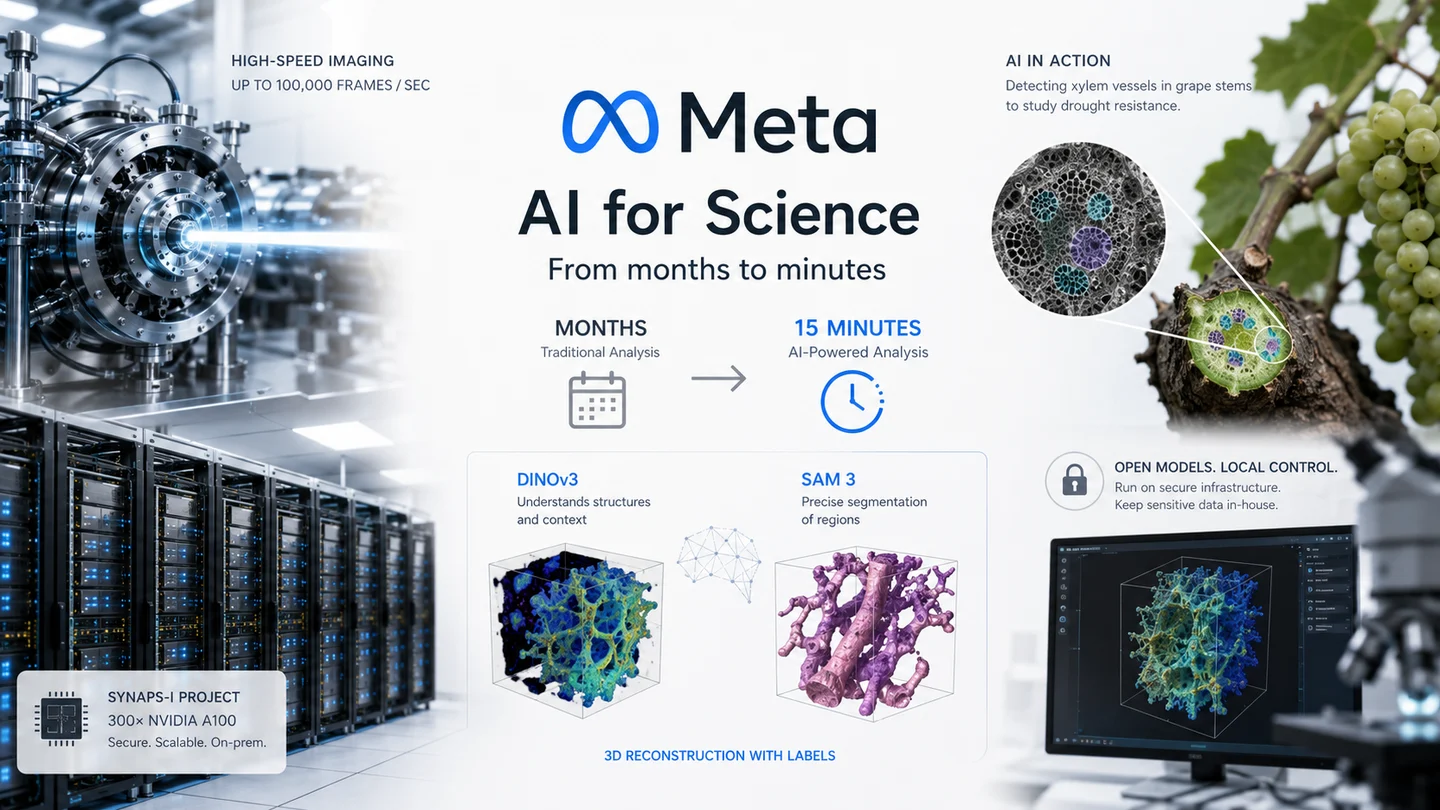
Meta says its open-source vision models are being used by U.S. national laboratories to turn scientific image analysis from a monthslong manual process into a near-real-time workflow.
The scientific bottleneck
Facilities such as Lawrence Berkeley National Laboratory’s Advanced Light Source generate enormous volumes of X-ray data. Modern detectors can capture up to 100,000 images per second, creating more data than researchers can manually inspect during an experiment.
A major part of the work is segmentation: identifying and drawing precise boundaries around structures such as cell walls, mineral grains, semiconductor layers or microscopic vessels inside plant tissue.
How the Meta models are used
The SYNAPS-I research initiative is combining Meta’s Segment Anything Model 3 and DINOv3. DINOv3 provides visual context and identifies structures, while SAM 3 produces precise pixel-level boundaries around them.
Researchers fine-tuned the models on scientific imaging data and deployed the pipeline across 300 NVIDIA A100 GPUs at U.S. national supercomputing facilities.
From raw scans to labelled 3D volumes
The system can reconstruct and label a three-dimensional scientific scan in approximately 15 minutes while the experiment is still running. Meta says a comparable annotation task previously required about one month of expert work for each time step.
A test case in drought research
The team used the pipeline to analyse micro-CT scans of grapevine stems. The models automatically identified xylem vessels, the microscopic structures that carry water through a plant, allowing researchers to track how they change during drought.
The resulting data could help scientists study plant resilience and support the development of crops better adapted to water stress.
Why open deployment matters
National laboratories often need to keep unpublished research data and customised models inside secure government infrastructure. Because SAM 3 and DINOv3 can be downloaded, fine-tuned and run locally, researchers do not need to send sensitive experimental data to an external cloud service.
Limits and next steps
The results come from a specialised scientific pipeline rather than a general-purpose deployment. Performance will depend on the imaging method, training data, hardware and quality of domain-specific fine-tuning.
SYNAPS-I currently involves around 60 researchers across five national laboratories and aims to extend real-time AI analysis to more X-ray and neutron-science workflows.
Practical significance
The project shows how open vision models can become part of scientific instruments rather than separate post-processing tools. Faster interpretation can let researchers adjust experiments while they are still running instead of waiting weeks for manual analysis.
Meta described the project in an official research post .
Source: Meta AI