Microsoft expands Azure AI infrastructure with AMD Helios
Published
Microsoft is expanding Azure's artificial intelligence and high-performance computing infrastructure through a broader partnership with AMD. The compa...
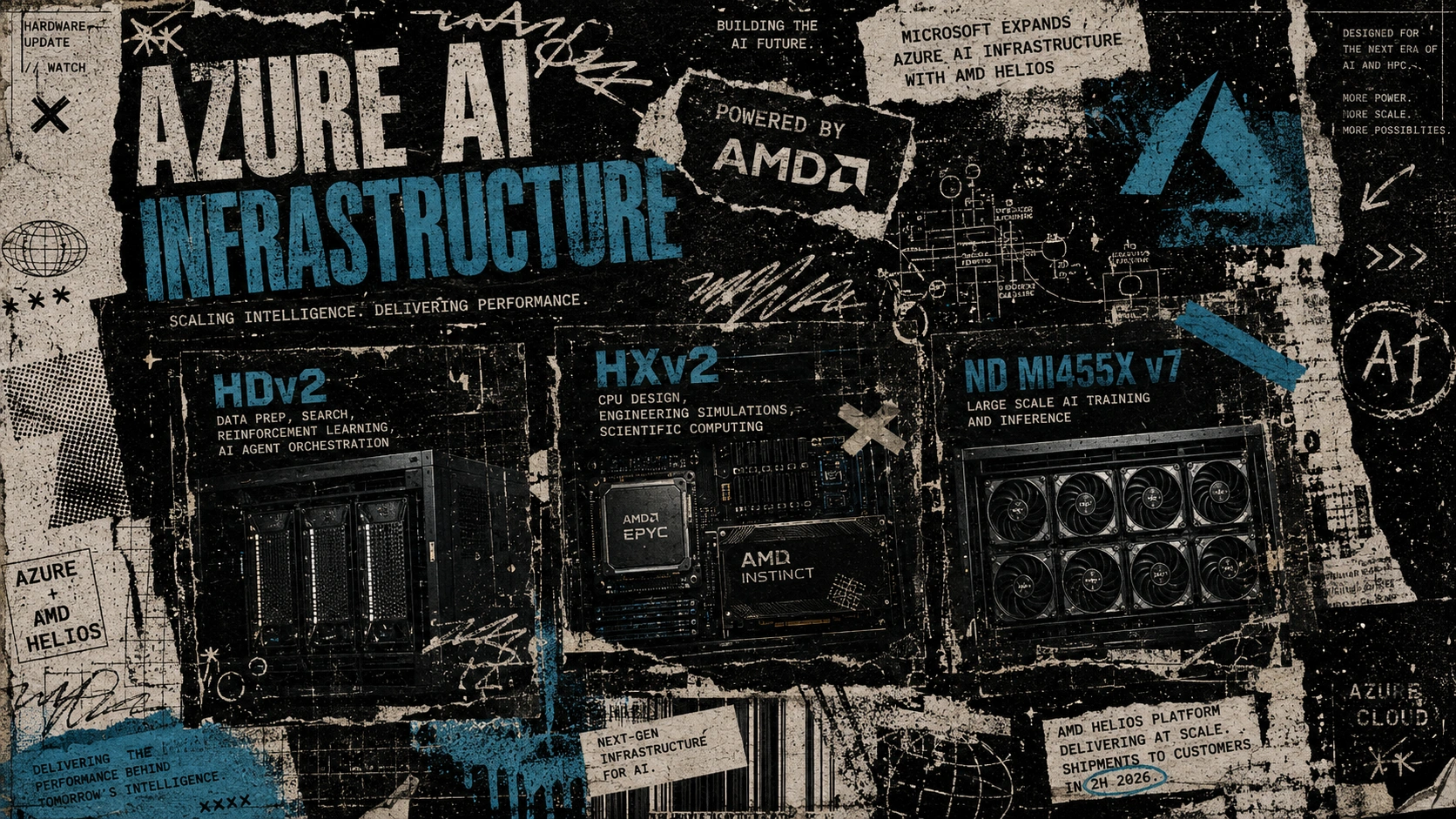
Microsoft is expanding Azure's artificial intelligence and high-performance computing infrastructure through a broader partnership with AMD. The companies announced three upcoming Azure virtual machine families built around AMD's latest rack-scale AI platform and sixth-generation EPYC data-center processors.
The expansion covers several parts of the AI computing stack rather than a single accelerator. Microsoft plans to add the AMD Helios rack-scale platform for large-scale inference, new CPU-based systems for AI data processing and semiconductor design, and a wider deployment of AMD Pensando data processing units in Azure networking.
Three new Azure infrastructure offerings
The first system, Azure HDv2 , is designed for CPU-intensive stages of modern AI workloads, including data preparation, search, reinforcement learning and the coordination of agent-based applications. Microsoft says each HDv2 virtual machine will provide nearly 500 physical sixth-generation AMD EPYC cores, 4 TB of memory, 32 TB of local NVMe storage and 400 Gb Azure Boost networking.
Azure HXv2 is aimed at electronic design automation and other technical computing workloads. The planned configuration includes 176 sixth-generation AMD EPYC cores running at more than 5 GHz, 50 percent more addressable cache per core than the previous generation, memory options approaching 2 TB or 4 TB, and 800 Gb InfiniBand connectivity. Microsoft positions the system for chip simulation, scientific computing and engineering analysis.
The third offering, Azure ND MI455X v7 , will use AMD's Helios rack-scale platform for production AI inference. Helios combines AMD Instinct MI455X GPUs, EPYC “Venice” CPUs, Pensando networking and the ROCm software stack. Microsoft says the Azure configuration is intended for reasoning, search and agentic workloads behind large AI services.
Networking and software are part of the agreement
The partnership also extends to the infrastructure that connects the processors. Azure will broaden its use of AMD Pensando DPUs and integrate AMD technology with Azure Boost, Microsoft's hardware-accelerated networking architecture. The goal is to improve connection processing, efficiency and network performance as AI clusters scale across more servers.
This matters because large AI systems depend on more than GPU throughput. Data must be prepared and moved quickly, agents need CPU capacity to coordinate tasks, and inference clusters require high-bandwidth networking to keep accelerators supplied with work. Microsoft's announcement presents the AMD systems as a set of specialized components for those different stages.
Availability and open questions
AMD says it expects to begin shipping Helios to customers, including Microsoft, in the second half of 2026. The official announcements do not provide exact general-availability dates or pricing for the HDv2, HXv2 and ND MI455X v7 virtual machines.
Microsoft is framing the expansion as part of a heterogeneous Azure infrastructure strategy that combines partner hardware with its own purpose-built silicon. For customers, the practical result should be a broader choice of computing architectures for model inference, AI data systems, chip development and scientific workloads.
Microsoft published the Azure infrastructure announcement on July 20, 2026. AMD released a corresponding partnership announcement with additional details about Helios, Pensando networking and the expected shipping window.
Source: Microsoft