Tesla's new Roadster takes flight with SpaceX thrusters, but production waits until 2028
Published
Tesla has unveiled a redesigned second-generation Roadster with cold-gas thrusters developed alongside SpaceX. At a demonstration in Texas on October ...
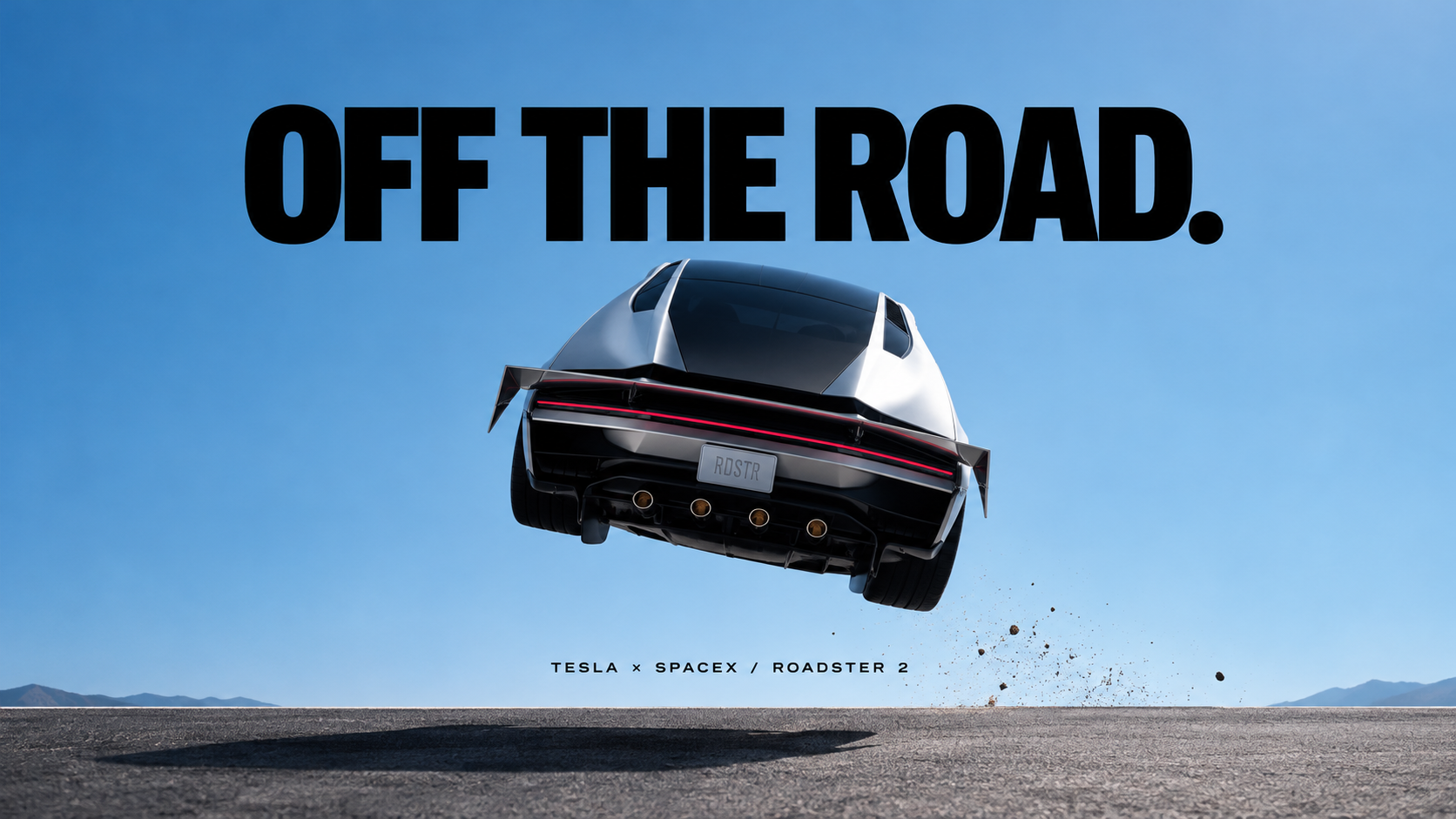
Tesla has unveiled a redesigned second-generation Roadster with cold-gas thrusters developed alongside SpaceX. At a demonstration in Texas on October 15, the electric sports car drove upside down on a curved ramp, rotated in midair, landed on its wheels and made a separate powered jump over a line of Tesla vehicles.
A Roadster that can leave the road — briefly
The stunt combined two distinct systems. A powerful fan-based suction system helped hold the prototype against an inverted section of the ramp. Compressed-gas thrusters then controlled its movement once it left the structure. Tesla also demonstrated a leap over vehicles including a Cybertruck and Cybercab.
That is a striking demonstration of controlled airborne maneuvers, but it is not evidence of sustained flight or a road-approved flying car. The Roadster shown was a demonstration prototype, and the legality of thruster-assisted maneuvers on public roads remains unresolved.
SpaceX technology meets an electric supercar
Tesla engineering chief Lars Moravy described a system using multiple cold-gas thrusters and approximately 600 liters of compressed air. Unlike a fuel-burning rocket engine, the system expels stored high-pressure gas. Tesla says the approach can support rapid acceleration and short bursts of airborne control.
The demonstration was remotely controlled for safety, according to reporting from the event. That distinction matters: the public has not seen an independently verified consumer-ready car repeatedly performing these maneuvers in ordinary driving conditions.
Three versions, different capabilities
Tesla outlined three configurations. The two-seat Performance version focuses on on-road and track performance with active aerodynamics and suction-based grip. The two-seat Thrust adds rear-mounted acceleration thrusters. The single-seat Rocket is described as an invitation-only configuration with a more complete flight-control system.
After the event, Tesla advertised reservation deposits of $50,000 for Performance and $250,000 for Thrust. These are deposits, not confirmed final prices. The company did not announce a definitive retail price, and the Rocket configuration is not presented as a conventional street-legal vehicle.
Under one second to 60 mph — according to Tesla
Tesla demonstrated acceleration from zero to 60 mph in under one second and cited a top speed exceeding 230 mph. It also described a range of more than 300 miles. The figures are company claims from the unveiling; independent certification, production specifications and full testing data were not provided.
Production is now planned for 2028
The second-generation Roadster was first shown in 2017, with deliveries originally expected in 2020. After years of delays, Elon Musk now says production should begin in 2028. Tesla has not supplied a firm customer-delivery schedule.
Why the reveal matters
The Roadster is a showcase for extreme vehicle engineering rather than a near-term mass-market transportation product. It puts Tesla and SpaceX technology on the same stage at a moment when Tesla is increasingly defined by autonomous driving, robotaxis and humanoid robotics. Whether its most dramatic features become legal, repeatable consumer capabilities remains an open question.
The demonstration can be watched in Tesla’s official event replay . Details about the configurations, performance claims and planned schedule were reported by TechCrunch and Reuters .
Source: TechCrunch