
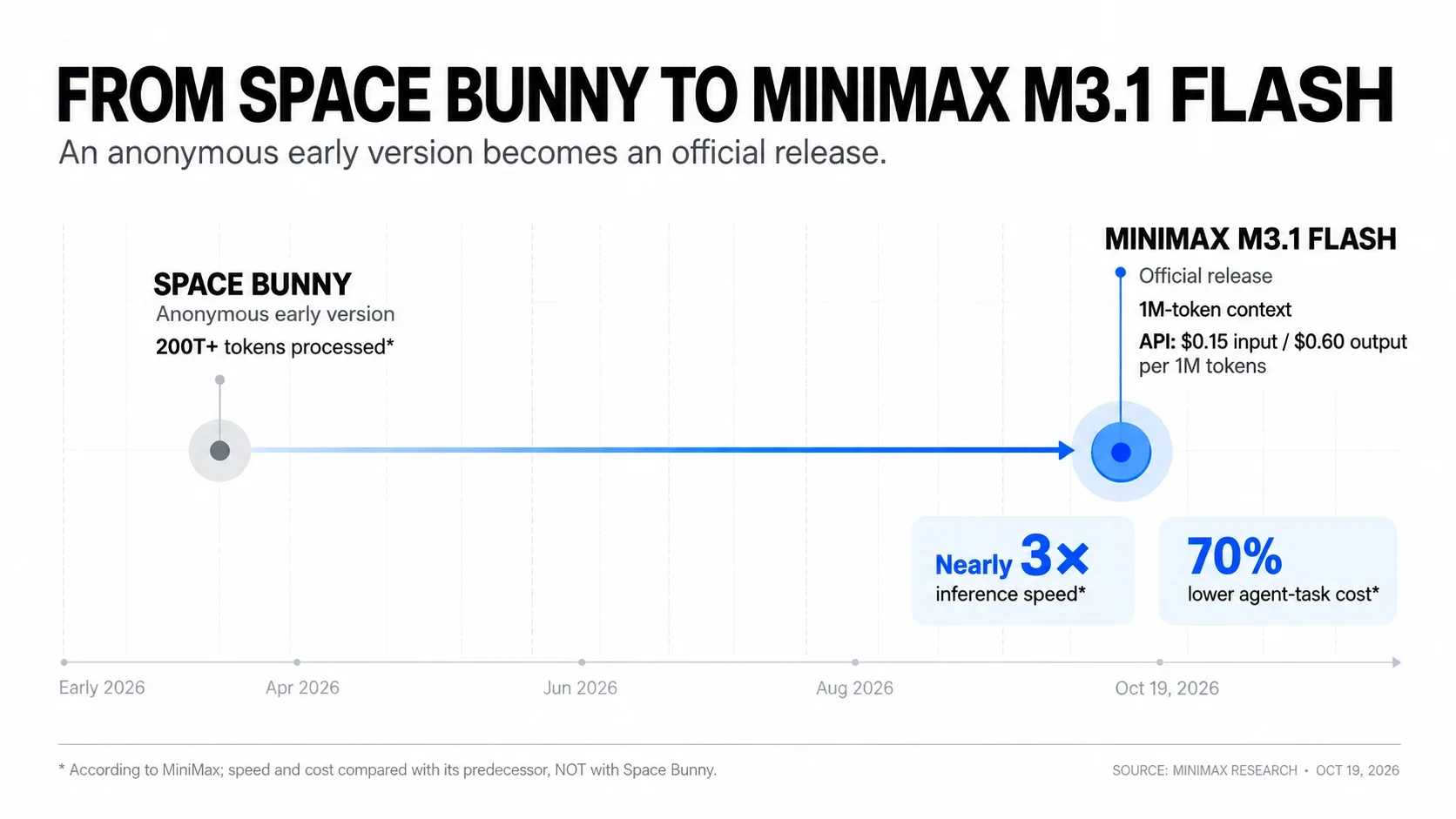
MiniMax officially released M3.1 Flash on October 19, 2026, positioning the new AI model around a metric that matters to developers running autonomous agents: the cost of finishing a task, not just the price of generating one answer. The company says online inference is nearly three times faster than before and that overall usage costs for agentic workloads are 70% lower than on its predecessor. Those are MiniMax's own comparisons, not a universal guarantee for every deployment.
The launch also solved a small AI mystery. MiniMax identified the previously anonymous 'Space Bunny' as an early version of M3.1 Flash, saying the model processed more than 200 trillion tokens during that period. The figure describes reported usage volume, not a third-party score for accuracy or capability.
What is MiniMax M3.1 Flash?
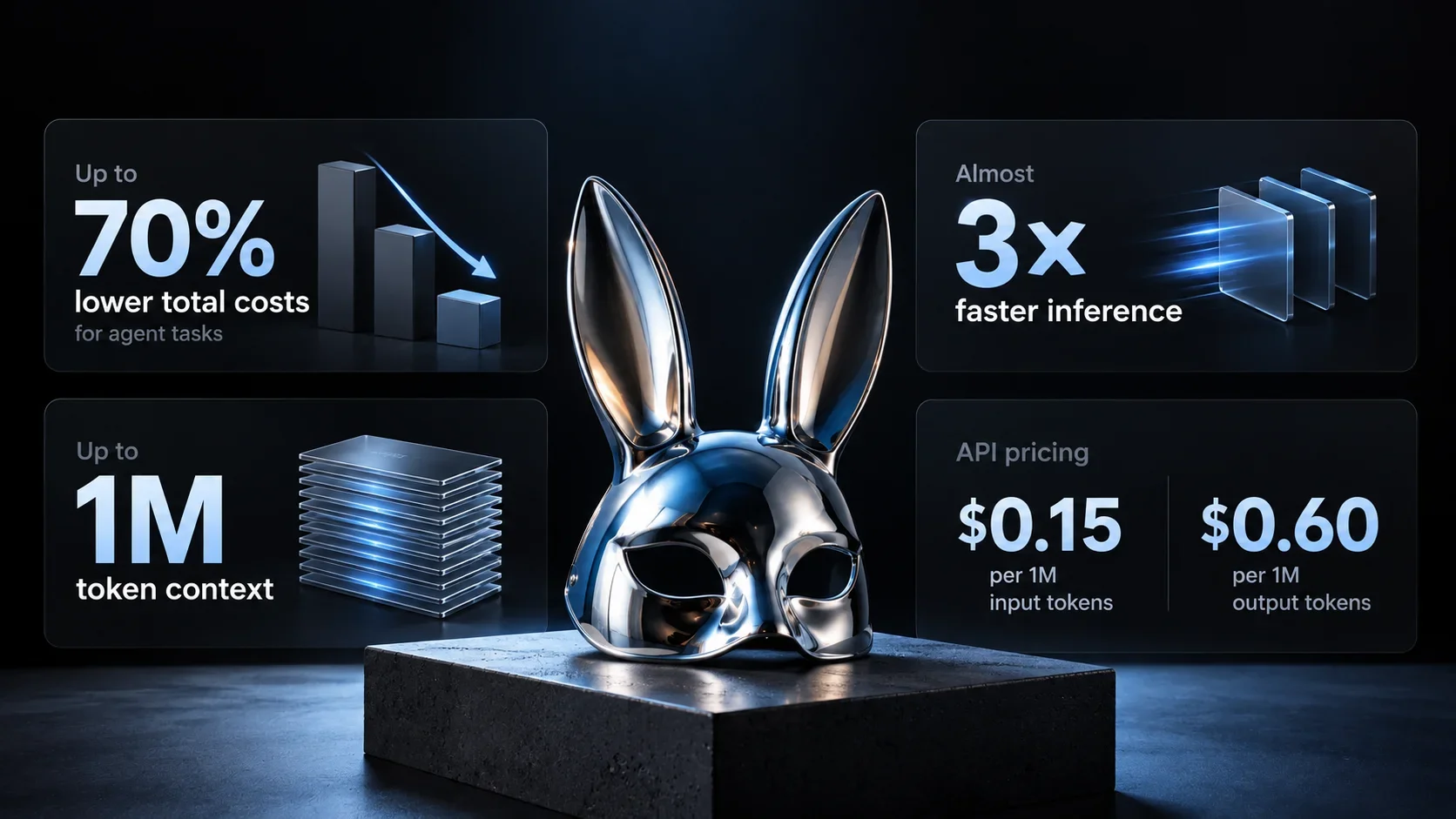
M3.1 Flash is a reasoning-oriented language model built for tool use, software engineering, computer interaction and long-running workflows. MiniMax's developer documentation lists a context window of up to one million tokens and supports multimodal inputs, including text, images and video, with text output. A large context window lets an application submit substantial source material or long agent histories, but it does not by itself prove that the model will reliably recall every detail.
The model can be called through an OpenAI-compatible API or an Anthropic-compatible interface. Developers can set the depth of its reasoning to low, medium, high, xhigh or max. Reasoning is enabled by default and cannot be fully switched off, according to the current documentation. This distinction matters when estimating latency and output-token spending.
MiniMax M3.1 Flash pricing: $0.15 input and $0.60 output
MiniMax published the following flat API rates, denominated in US dollars per one million tokens:
- Input tokens: $0.15 per 1 million.
- Output tokens: $0.60 per 1 million.
- Cached input tokens: $0.015 per 1 million.
For an illustrative API run with 500,000 uncached input tokens and 100,000 billed output tokens, those rates add up to $0.135 before any separate charges or billing conditions. That is a calculated example, not a measured typical agent session. Actual cost depends on how much context an agent repeatedly sends, how many calls it makes, how many reasoning tokens it generates and how effectively prompts can be cached.
Importantly, the headline 70% reduction refers to the company's estimate of overall agentic-task costs relative to its predecessor. It is not a claim that each token price is 70% lower. Comparing the advertised M3.1 Flash input and output rates with prices shown for MiniMax M3 in independent model listings suggests roughly half the per-token rate, whereas task-level savings may move differently as model speed, output length and retries change.
How fast is it, and what do the benchmarks actually show?
MiniMax credits more aggressive sparsity for its efficiency gains. It reports that everyday generation can exceed 200 output tokens per second, with a median (P50) above 170 tokens per second. Those values are vendor-reported service measurements, not a promise for every user, region, prompt length or provider.
The company's launch material reports 73.7% on DeepSWE v1.1 for software-engineering tasks, 61.7 points on OSWorld V2 for computer use, and 82% on CyberGym for cybersecurity work. These benchmarks examine different skills under specific evaluation setups; their scores should not be combined into a single 'accuracy' percentage. MiniMax also reports a score of 76.2 on BankerToolBench for complex financial workflows.
An independent Artificial Analysis profile lists an Intelligence Index score of 42 for M3.1 Flash. That is useful additional context, but it measures a different evaluation suite and should not be presented as independent replication of MiniMax's DeepSWE, OSWorld or CyberGym numbers. As with any model launch, production teams should test their own success rate, latency and cost on representative tasks before moving traffic.
A practical use case: an AI coding agent that keeps working
Consider a coding assistant asked to trace a failing test across several files, suggest a fix, update the code and rerun checks. Instead of paying attention only to the price of one generated answer, the developer must budget for repeated file reads, tool calls, reasoning steps, failed attempts and final verification. A model optimized for agent workflows could make those extended loops cheaper, but only if it consistently resolves enough issues without creating expensive retries.
A sensible evaluation compares M3.1 Flash with an existing model on the same small set of real tickets: completion rate, number of tool calls, elapsed time, review corrections and total billed tokens. Those measurements can reveal whether a lower token price actually results in a lower cost per accepted code change. For security workflows, model findings still need human validation and controlled tool permissions.
How to use MiniMax M3.1 Flash through the API
MiniMax already documents an OpenAI-compatible chat-completions endpoint. The following minimal request follows the provider's documented model identifier and parameter names; replace the environment variable with a valid API key before testing it:
curl https://api.minimax.io/v1/chat/completions \
  -H "Authorization: Bearer $MINIMAX_API_KEY" \
  -H "Content-Type: application/json" \
  -d '{
    "model": "MiniMax-M3.1-Flash",
    "reasoning_effort": "medium",
    "messages": [
      {"role": "user", "content": "Review this Python function for edge cases."}
    ]
  }'
Set reasoning_effort to a higher level when deeper reasoning is worth the additional time and generated tokens. If reasoning overhead is expensive for a high-volume workload, test lower settings rather than assuming reasoning can be disabled. The exact response fields, quotas and operational limits should be checked against the current MiniMax API documentation.
Where is M3.1 Flash available, and are the weights open?
As of the October 19 announcement, MiniMax says M3.1 Flash is available through its API, the M Plan subscription and MiniMax Code. The announcement says model weights will be released later, without giving a firm release date. Developers should therefore not confuse today's hosted-model availability with confirmed self-hosting availability at launch.
MiniMax also says a more capability-focused 'Pro' version will follow. It did not commit to a launch date in the announcement. For now, the immediately usable part of the release is the hosted Flash model and its pricing.
Why the launch matters
The most important question for buyers of agentic AI is not whether a model can produce an impressive benchmark chart. It is whether an agent can complete a real workflow with fewer failed actions, less waiting and a predictable bill. MiniMax's new pricing sharpens that competition, while the Space Bunny reveal gives developers context for a model they may already have encountered under another name.
The claims are worth testing, not treating as settled. A 70% task-cost reduction would matter for production coding agents, enterprise automation and security analysis, but workload-specific evaluations remain essential. Speed, reliability, human oversight and model access are all part of the true total cost.