Electric Plant is building an AI system around an unusual input: the electrical activity of living plants. Its Bombadil model is intended to turn those recordings into information about plant condition. The useful question is not whether a tree can hold a conversation, but whether its signals can help someone care for it.
The company published its Bombadil white paper on October 19, 2026.
TechCrunch reported an $11.2 million seed round on October 20.
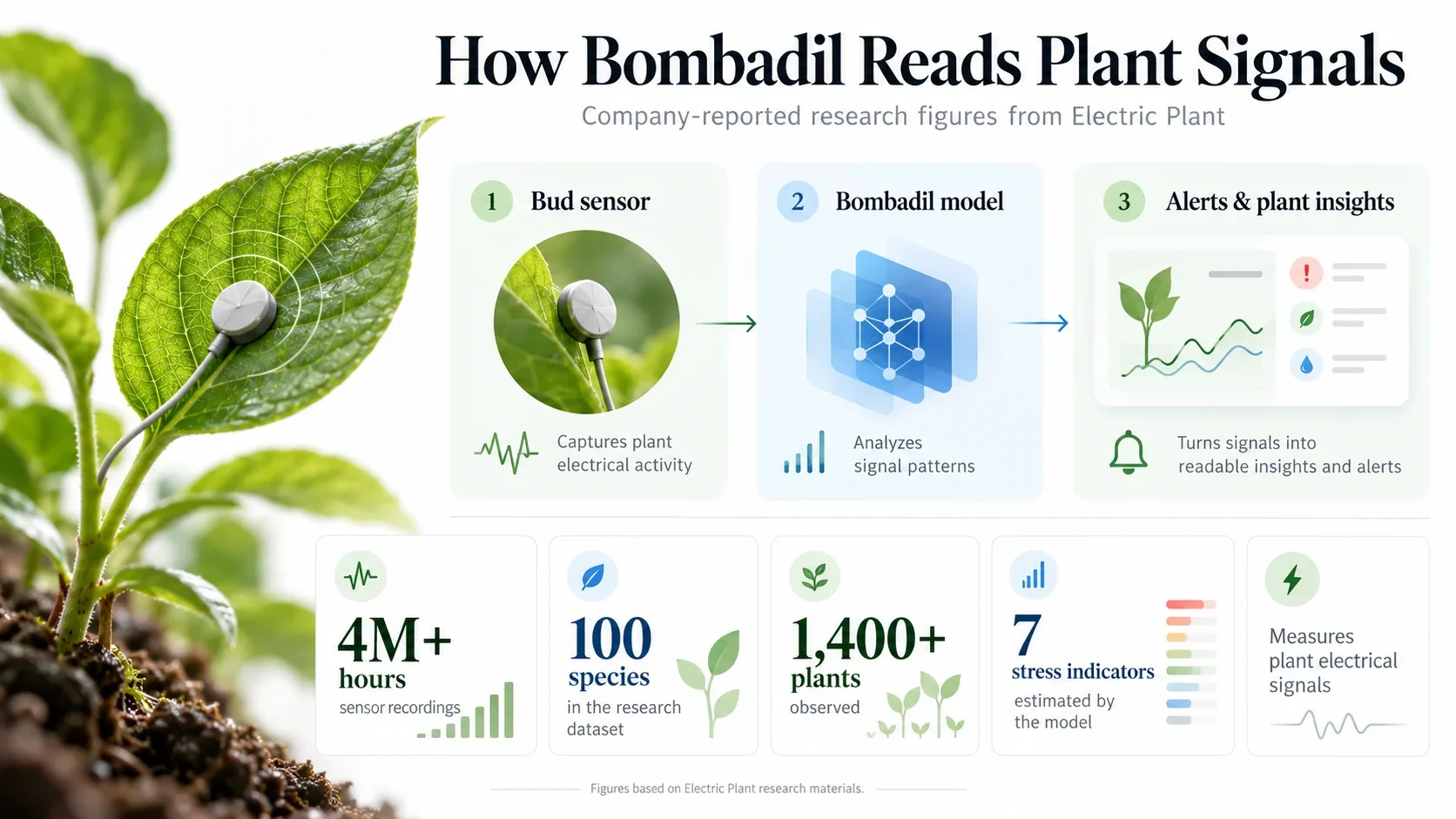
How Bombadil reads plant electrical signals
The paper describes a Transformer pretrained on more than four million electrode-hours from over 1,400 plants across 100 species. Electrode-hours measure accumulated sensor recording time, not the number of plants. The model processes time-series patches rather than sentences; a separate prediction head estimates seven physiological stress indicators. Source: methods and dataset.
That makes the distinction from a chatbot important. A useful plant-monitoring output would be a measurement or a warning that can be checked, not an eloquent sentence that sounds as though it came from a tree.
The biology is real; the conversation is a metaphor
Plant signaling predates this startup. In research published in Science in 2018, scientists visualized calcium signals spreading from damaged leaves to other parts of a plant. The University of Wisconsin–Madison described how glutamate, electrical signaling and calcium waves help coordinate defensive responses. Plants can distribute information about damage without an animal nervous system.
That research establishes a biological basis for investigating plant signals. It does not independently validate Bombadil, demonstrate that electrical recordings contain human-style language, or establish that a particular commercial sensor can reliably diagnose every cause of stress.
Electric Plant’s background explainer also describes several kinds of electrical activity that can overlap. That is a useful reason to treat the recordings as physiological data requiring interpretation, rather than imagine a simple dictionary in which one voltage pattern always translates to “water me.”
What the hardware and software actually do
The company’s product description presents three connected elements. Bud is a probe that continuously records plant electrical signals. Bombadil interprets those signals. An additional software layer turns the information into dashboards, alerts and agents configured for the customer’s operation.
Electric Plant identifies orchards, tree crops, forestry, landscaping and research as possible applications. Those are proposed uses, not interchangeable proof of performance: monitoring an orchard and assessing groundwater contamination would require different evidence.
A practical use case: deciding which trees need inspection
Electric Plant’s FAQ says the system can provide information about hydration, stress and environmental responses. It describes on-site calibration and leaves decisions about intervention to the grower.
Consider an illustrative orchard workflow, not a reported customer result. A grower could use a warning to select trees for inspection, compare their condition with irrigation records and other measurements, and investigate a possible watering problem. The valuable outcome would be a better decision made earlier, not simply another dashboard.
A sensible pilot would compare monitored and control areas, record missed problems as well as false alarms, and measure whether the alerts changed useful actions. Water consumption, plant condition and staff time should be evaluated separately. A signal model should earn its place in that workflow before anyone treats it as an automatic irrigation controller.
What the research does not establish
Results vary by species; the authors report failure on Codiaeum variegatum in a small test sample. They also distinguish tracking change from estimating an accurate absolute level. These are company-reported findings, not independent validation. See results and limitations.
The FAQ claims training on more than 125 species. That broader product claim should not be substituted for the research dataset described above; the two pages do not establish that their counts refer to the same model version.
For a prospective user, the essential question is narrower than “Does the AI understand plants?” It is whether the system gives reliable, actionable information for a specific crop, location and decision.
Availability and pricing
Access is through contacting Electric Plant, with installation and calibration handled alongside its team. The reviewed product and FAQ pages do not list a retail price, a self-service app download or an API tariff. It should therefore be evaluated as a deployment project, not presented as a consumer chatbot anyone can immediately try.
Bombadil’s appeal is the possibility of making a difficult biological signal useful outside a specialist experiment. The next meaningful milestone would be independently documented field performance: clear evidence that its readings improve decisions under real operating conditions.
Reporting note: PROMT.EXE reviewed the company’s public documentation and research, alongside the sources linked above. We have not tested the hardware or independently reproduced the results. The orchard workflow is an editorial example, not a customer case study.