
Tuesday Labs is taking reservations for Voxel Series-1, a proposed home robot intended to tidy rooms and help find misplaced belongings. Its reservation page asks for a refundable $200 payment and targets initial shipments in 2028. That is a reservation fee, not the price of the robot.
The launch received coverage from The Verge on October 20, 2026. The more important qualification is in Tuesday Labs’ own paperwork: the machine shown today is a development prototype, not the final product.
What is Voxel supposed to do?
Tuesday Labs’ product page describes four intended jobs: putting household objects away, reporting where an item was last seen, fetching things such as books or keys, and watering plants. These are advertised capabilities, not results from a PROMT.EXE hands-on test.
The distinction between finding and fetching is useful. Knowing where an object was observed does not guarantee that it is still there. Our proposed test would move an item after the robot sees it, then check whether its response acknowledges uncertainty instead of confidently reporting an outdated location.
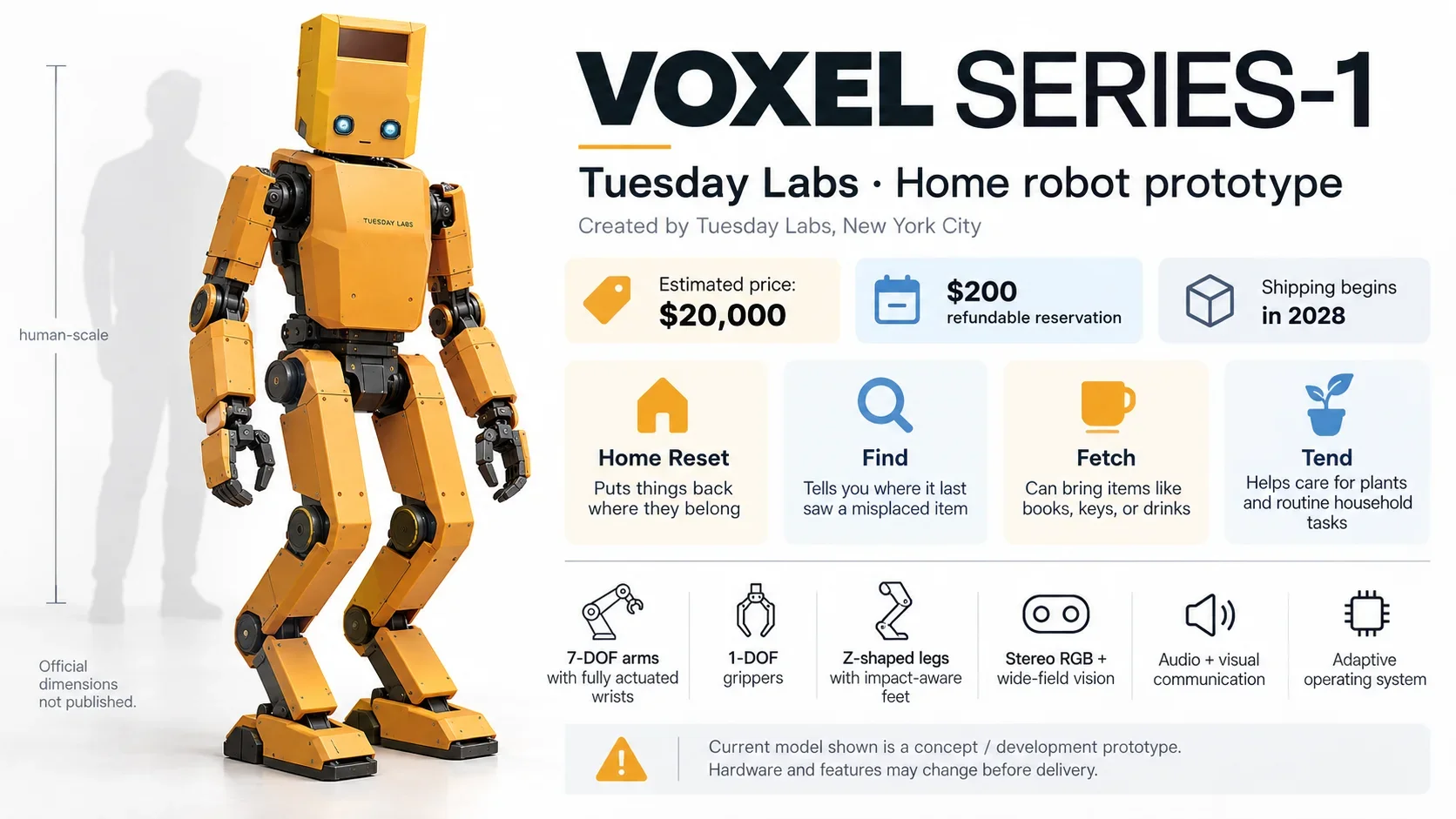
The hardware is built around household interaction
The published design includes two seven-degree-of-freedom arms, one-degree-of-freedom grippers, Z-shaped legs, and stereo RGB plus wide-field vision. Tuesday Labs describes the arms as designed to work around counters, shelves and other fixed household geometry.
A specification sheet is only a starting point. For a useful household assistant, we would want to see repeatable object handling in cluttered rooms, not simply evidence that the robot has enough joints to reach a shelf. That is an evaluation criterion, not a result claimed here.
Who is behind Tuesday Labs?
Y Combinator’s company profile identifies founder Rosalind Shinkle as a former staff robotics engineer on Boston Dynamics’ Spot Manipulation team. Her work included algorithms governing how Spot’s arm interacted with its surroundings. Tuesday Labs was part of YC’s Winter 2024 batch.
That background is relevant to a machine intended to handle real objects. It does not, by itself, establish how reliably Voxel performs household tasks. Experience building manipulation systems and evidence that a particular consumer product works are different kinds of information.
In its company statement, Tuesday Labs argues that home robots should reduce maintenance and leave people with more time away from screens. It lists backing from Y Combinator and FCVC. Our reading of that positioning is straightforward: the intended benefit is less household administration, not another interface demanding attention.
Voxel price, reservations and the 2028 delivery target
The reservation agreement gives an estimated price of $20,000, explicitly subject to change. Reservations are limited to U.S. delivery addresses. Tuesday Labs expects substantial hardware redesign before delivery, so appearance, features and specifications may change significantly. Deliveries are expected to begin in 2028 but may be later. An edition number does not guarantee delivery order.
The separate reservation page explains that holders will be emailed when the robot is ready to order. It describes the $200 payment as fully refundable and presents the reservation as the right to buy from the first production run. Reserving today should not be confused with purchasing a finished machine that is ready to ship.
What remains unclear about home data?
Tuesday Labs’ published privacy policy, updated October 19, covers its website, mailing list, purchases and reservations. It describes transaction-related processing, including payments through Stripe. It is not a detailed technical description of the future robot’s camera or microphone data pipeline.
Before treating Voxel as a home-memory system, readers would need answers about local versus cloud processing, retention of recordings or spatial maps, deletion controls, guest privacy and any human remote assistance. We could not establish those details from the pages reviewed. That is an information gap, not evidence of improper data handling.
What would make this more than an appealing demonstration?
For an independent evaluation, we would want uncut household trials, repeated tasks in different rooms, completion rates, and a count of human interventions. Any remote operator should be disclosed. Those are our proposed reporting standards, not benchmark results that we are attributing to Voxel.
The promise is appealing because the jobs are ordinary. A machine that consistently removes small daily interruptions could be more useful than one that performs an impressive one-off trick. The open question is whether Voxel can do that reliably enough to justify its eventual price.
Reporting note: This article reviews public company materials, the reservation agreement, Y Combinator’s profile and dated news coverage. PROMT.EXE has not tested Voxel. Product capabilities remain manufacturer claims; our suggested tests are editorial analysis.